
anti-defensive-writing
Codex skill for removing defensive writing and strengthening prose.
 Kiterlin
- 评测生成时间(北京时间)
- 本报告引擎
- v3.17.3
- 当前引擎
- v3.17.3
规则版本一致,但报告只反映生成时的证据,不代表项目代码和安全状态始终不变。
进入后确认来源与额度,提交才会创建任务。
核对代码版本与送评文本摘要
仅记录实际送评的受限文本,不是完整仓库审计、安装结果或运行时安全保证。Stars、下载量和仓库元数据为采集时的独立信号,不属于此 commit 快照。
Kiterlin/anti-defensive-writing @ f516147d017a3fe43ae99192cb89d8261b0c8679目录树:711671bd7154feef21ab1c4cf87d0ec6f3df5146
README 来源:README.md
- README.md · 18969 字符
SHA-256: d537abf9822bd28271cc14ad1db06e41143fd3c2bea70d3a868deecce73ca0e5 - SKILL.md · 15819 字符
SHA-256: 287e3d05aeabf6409fa53b74a124ee0d897338009be2c04d3e38c352ca74a3c1 - skill/anti-defensive-writing/SKILL.md · 15819 字符
SHA-256: 287e3d05aeabf6409fa53b74a124ee0d897338009be2c04d3e38c352ca74a3c1
摘要对应送评 UTF-8 文本,可能为限额节选,不等于 Git blob SHA。来源由采集方提供,摘要本身不证明来源真实性。
综合采用结论
检测到关键风险,修复前不建议接入
- 基础评测完成+25/25确定性评分与静态安全扫描已完成
- README 有效证据+25/2516,003 个去重后的有效字符
- 独立证据来源+8/202 类非重复证据,重复文件不叠加
- 仓库元数据+10/10已取得仓库状态与采用数据
- 活跃记录+5/5已取得最近提交时间
- AI 复核+15/15已完成结构化 AI 证据复核
本报告评了什么
综合分用于静态采用筛选,不是任务成功率,也不代表使用 Skill 后的能力提升。
- 静态检查范围
- 记录 3 个文件 · 50,607 字符
- 只检查采集到的受限文本与已知风险模式;未读取的脚本、依赖和运行环境不在结论内。
- AI 内容复核
- 已使用
- 复核送评文本的说明和设计,不是安装测试或实际任务执行。记录缺失时不推断已使用或未使用。
- 真实任务效果
- 本报告未提供实测证据
- 没有使用/不使用 Skill 的任务对照、重复运行或耗时与 token 成本结果。采用前仍需在隔离环境验证自己的任务。
脚本引用覆盖
脚本引用覆盖记录不可得;不推断没有引用或已经检查。
防御性写作改写五步流程
SKILL.md 的 Rewrite Procedure 为单一文本的连续处理步骤,无多方请求响应
左右滑动查看完整图示
- • SKILL.md “Rewrite Procedure” 第1步:Identify the function of the defensive sentence
- • SKILL.md “Rewrite Procedure” 第5步:Rebuild the paragraph around the main point
- 通过: Agent Skills 格式校验 2/2 个通过
- 通过: 2 个有效 Skill 含可核实的指令步骤或示例
- 质量评审选取 SKILL.md;其余 1 个仅做格式扫描
- SKILL.md “Rewrite Procedure” 列出识别、删除免责声明、转正向范围、替换模糊限定、重组段落五步
- SKILL.md “Methodological Guardrails” 声明禁止编造事实、指标、基线与因果越界
- README “Quickstart” 给出 curl 管道安装命令与 --dest/--force/--ref 参数
- README “Upgrades & Version Pinning” 说明原子替换但未提供下载校验
- SKILL.md “Using the Examples” 要求“三种制度环境”等表述须有原稿依据
- 问题与用途描述
- 有效 README
- 可执行示例
- 输入、参数或工具说明
- 通过: Agent Skills 格式校验 2/2 个通过
- 发现高风险的一键下载执行或安装命令
- 缺少安装或接入步骤
- 缺少错误处理或排障
- 无错误处理或排障章节,安装失败、路径错误时无指引
- 安装依赖 curl 管道执行远程脚本,未说明校验或回滚细节
学术论文摘要、引言、贡献段与结论的措辞强化、中文技术方案与 SOP 去除说教和冗余语气、审稿回复与 rebuttal 的直接化改写、需要保留方法与伦理限定的专业报告写作
需要自动校验改写是否引入新事实的严格合规流程、无网络环境且无法手动放置 SKILL.md 的部署场景
也有自己的公开项目?先看完证据,再用当前规则生成独立报告。
评测我的项目 →unsafe-install-commandREADME.md:177high confidencecurl -fsSL https://raw.githubusercontent.com/Kiterlin/anti-defensive-writing/main/install.sh | sh -s -- --dest "$H***ls"修复:固定版本与校验和,先下载审查再执行,避免管道直接交给 Shell。
unsafe-install-commandREADME.md:182high confidencecurl -fsSL https://raw.githubusercontent.com/Kiterlin/anti-defensive-writing/main/install.sh | sh -s -- --dest "$H***ls"修复:固定版本与校验和,先下载审查再执行,避免管道直接交给 Shell。
unsafe-install-commandREADME.md:187high confidencecurl -fsSL https://raw.githubusercontent.com/Kiterlin/anti-defensive-writing/main/install.sh | sh -s -- --dest "$H***ls"修复:固定版本与校验和,先下载审查再执行,避免管道直接交给 Shell。
unsafe-install-commandREADME.md:214high confidencecurl -fsSL https://raw.githubusercontent.com/Kiterlin/anti-defensive-writing/main/install.sh | sh -s -- --dest "$H***ls" --force修复:固定版本与校验和,先下载审查再执行,避免管道直接交给 Shell。
unsafe-install-commandREADME.md:217high confidencecurl -fsSL https://raw.githubusercontent.com/Kiterlin/anti-defensive-writing/main/install.sh | sh -s -- --dest "$H***ls" --ref <commit-hash>修复:固定版本与校验和,先下载审查再执行,避免管道直接交给 Shell。
- 01固定版本与校验和,先下载审查再执行,避免管道直接交给 Shell。
- 02补充安装或接入步骤
- 03补充错误处理或排障
方法、证据与局限展开收起
GitHub Repository API
3 个文件 · 50,607 字符
v3.17.3 · AI 内容复核:已使用(deepseek-flash)
- 静态评测不会安装或执行项目代码
- 安全扫描基于高信号文件与已知模式,不能替代人工审计
- 流行度只反映采用程度,不代表安全或工程质量
- 发现 2 个 Skill;质量复核只评审 SKILL.md,其余 1 个仅做格式扫描
README
Anti-Defensive Writing
Calibrated Assertiveness & Positive Scope for Academic and Technical Prose






Abstract • Core Principles • Comparative Analysis • Rewrite Pipeline • Quickstart • Agent Interface • Case Studies • BibTeX
English | 简体中文
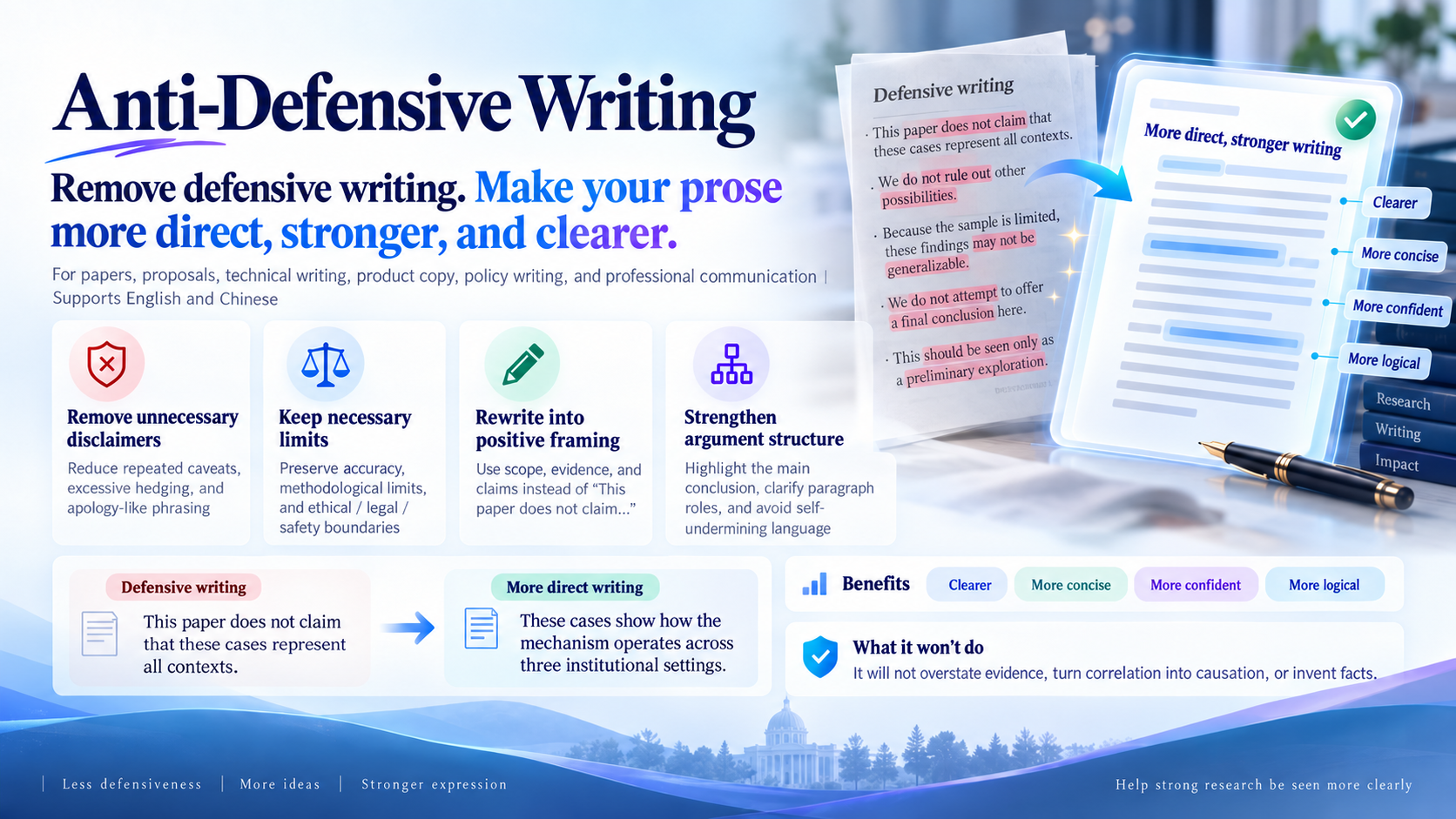
Figure 1: The Anti-Defensive Writing Paradigm. Systematically removing premature apologies, redundant disclaimers, and layered hedges while rigorously anchoring empirical scope and methodological boundaries.
Abstract
Abstract — Scholarly and technical communication is frequently weakened by defensive writing: an authorial posture characterized by pre-emptive apologies, repetitive disclaimers, stacked modal hedges, and negative self-deprecation. While intended to ward off hypothetical criticism, defensive habits dilute the empirical strength of claims and obscure core scientific contributions.
Anti-Defensive Writing introduces an agentic skill specification that systematically diagnoses and eliminates defensive cognitive overhead while strictly preserving methodological validity, empirical scope, and ethical/legal boundaries. By replacing defensive disclaimers with positive scope definitions and calibrating uncertainty to observed evidence, this framework enables researchers and professionals to communicate findings with authoritative clarity, structural focus, and maximum signal-to-noise ratio.
The complete operational rulebook and multilingual instructions are codified in SKILL.md (comprising English Core Rules, English Extended Guidelines, Chinese Core Rules, and Chinese Extended Guidelines).
Core Principles
The framework establishes four fundamental pillars for rigorous, claim-forward academic communication:
| Pillar | Academic Posture | Operational Directive |
|---|---|---|
| 🎯 Claim-Forward Articulation | Assertive & Direct | Lead paragraphs and contribution sections with empirical discoveries and theoretical arguments, rather than defensive preambles. |
| 📐 Positive Scope Delimitation | Constructive & Bounded | Define boundaries by stating what the investigation does analyze, test, and explain—abandoning reflexive "We do not claim that..." formulations. |
| ⚖️ Calibrated Uncertainty | Rigorous & Precise | Differentiate between legitimate empirical limits and timid hedge stacking ("may potentially suggest"); anchor uncertainty directly to concrete design constraints. |
| 🏗️ Structural Separation of Concerns | Modular & Cohesive | Place necessary methodological limitations in dedicated sections (Methods, Discussion, Limitations), preventing dilution of abstracts, introductions, and conclusions. |
Technical Plans and SOPs
In Chinese technical plans, SOPs, reports, and presentations:
Remove redundancy and admonitory tone while preserving technical meaning, applicability conditions, prohibitions, and operational purpose. Do not change the operation to make the text sound more concise or specialized.
- State the plan directly: Give the procedure, parameters, prerequisites, and findings. Remove commentary about the writing only when it adds no substantive information. Keep phrases such as “用于阐明机制” when they state a real research purpose.
- Name technical prerequisites: Replace vague wording such as “在条件允许时” with concrete prerequisites supported by the draft, for example, “标定前提:……”. Keep necessary conditions expressed by “仅在……时” or “若欲……需要……”, or rewrite them equivalently. Do not replace them with an unconditional action; identify missing conditions when they are unspecified.
- Use operational language: State the required handling directly and remove admonitory wording such as “切记”, while retaining necessary prohibitions and technical conclusions. Keep “不可互相替代” when it expresses a real restriction. Use “两者独立记录并平行分析” only when the procedure calls for it; this does not convey non-interchangeability.
- Choose precise verbs: Simplify redundant phrasing such as “进行……的测量” to “测量……”. “测量” and “表征” are valid technical verbs. Use “标定”, “解耦”, “淬灭”, or “钳定” only when they describe the actual operation; do not substitute a different operation to sound more specialized.
The Chinese guide includes the Chinese rules and examples.
Comparative Analysis
The table below contrasts conventional defensive drafts against revisions generated under the Anti-Defensive Writing paradigm across standard scholarly contexts.
| Rhetorical Dimension | Conventional Defensive Draft (❌) | Anti-Defensive Paradigm (✅) | Cognitive & Rhetorical Gain |
|---|---|---|---|
| Introduction & Hook | "Although it is beyond the scope of this modest preliminary inquiry to resolve platform governance debates, it might tentatively be suggested..." | "Algorithmic content moderation significantly reshapes user participation in online communities." | Immediate Empirical Focus: Commands reader attention by stating observed phenomena without evasive preamble. |
| Scope Delimitation | "We do not claim that our sample is representative of all municipal governance systems across regions." | "The analysis focuses on urban governance cases across three institutional jurisdictions from 2015 to 2023." | Positive Boundary Definition: Conveys exact empirical boundaries without defensive self-deprecation. |
| Uncertainty Calibration | "These experimental outcomes could potentially indicate that variable $X$ might possibly influence metric $Y$." | "The evidence indicates that $X$ influences $Y$ under the examined observational conditions." | Elimination of Hedge Stacking: Replaces multi-layered modal qualifiers with calibrated, evidence-bounded assertion. |
| Metric & Trade-off Framing | "The model achieved lower accuracy (89% vs. 90%), indicating clear performance shortcomings." | "The method reduces inference latency from 100 ms to 60 ms with 89% accuracy (compared to 90% for the baseline)." | Objective Trade-off Exposure: States system trade-offs neutrally without pathologizing valid Pareto frontiers. |
| Authorial Modesty | "This study merely attempts to take a minor exploratory step toward understanding..." | "This study establishes an empirical baseline for analyzing..." | Professional Authorial Posture: Replaces ritual modesty with calm, objective scientific authority. |
Rewrite Pipeline
Revising text with Anti-Defensive Writing follows a formal 5-stage transformation pipeline:
┌────────────────────────────────────────────────────────┐
│               Input: Defensive Academic Draft          │
└───────────────────────────┬────────────────────────────┘
                            │
                            ▼
┌────────────────────────────────────────────────────────┐
│  Stage 1: Functional Diagnosis                         │
│  Classify defensive units: Unnecessary Disclaimer vs.  │
│  Necessary Scope vs. Methodological Constraint         │
└───────────────────────────┬────────────────────────────┘
                            │
                            ▼
┌────────────────────────────────────────────────────────┐
│  Stage 2: Disclaimer Pruning                           │
│  Strip uninformative disclaimers and preemptive        │
│  apologies that contribute no empirical value          │
└───────────────────────────┬────────────────────────────┘
                            │
                            ▼
┌────────────────────────────────────────────────────────┐
│  Stage 3: Positive Projection                          │
│  Convert negative denials ("Not X") into               │
│  explicit positive definitions ("Focuses on Y")        │
└───────────────────────────┬────────────────────────────┘
                            │
                            ▼
┌────────────────────────────────────────────────────────┐
│  Stage 4: Uncertainty Calibration                      │
│  Collapse stacked modal hedges ("may potentially");    │
│  ground uncertainty in concrete observational limits   │
└───────────────────────────┬────────────────────────────┘
                            │
                            ▼
┌────────────────────────────────────────────────────────┐
│  Stage 5: Structural Realignment                       │
│  Anchor paragraphs with decisive topic sentences;      │
│  isolate true constraints to dedicated sections        │
└───────────────────────────┬────────────────────────────┘
                            │
                            ▼
┌────────────────────────────────────────────────────────┐
│          Output: Assertive, High-Signal Paper          │
└────────────────────────────────────────────────────────┘
Quickstart
Deployment Footprint
The installation is engineered to be minimal, hermetic, and zero-overhead. Only a single specification file is deployed into your target skills environment:
<skills-directory>/
└── anti-defensive-writing/
    └── SKILL.md
Zero Runtime Dependencies: The installer streams
SKILL.mddirectly. It does not clone repository archives, nor does it install README files, scripts, images, test suites, or auxiliary configurations. It requires no Git, Python, Node.js, compilation toolchains, or package managers.
Supported Environments
| Target Environment | Global (User-Level) Destination | Local (Project-Level) Destination |
|---|---|---|
| Codex (Recommended) | ~/.agents/skills | .agents/skills |
| Codex (Legacy Runtime) | ~/.codex/skills | .codex/skills |
| Claude Code | ~/.claude/skills | .claude/skills |
Note: ~ denotes your user home directory. Relative paths resolve from the execution directory. For project-level installations, execute commands directly from the project root.
Installation via Shell (macOS / Linux / WSL)
Choose one command corresponding to your target agent:
Standard Codex (~/.agents/skills)
curl -fsSL https://raw.githubusercontent.com/Kiterlin/anti-defensive-writing/main/install.sh | sh -s -- --dest "$HOME/.agents/skills"
Legacy Codex (~/.codex/skills)
curl -fsSL https://raw.githubusercontent.com/Kiterlin/anti-defensive-writing/main/install.sh | sh -s -- --dest "$HOME/.codex/skills"
Claude Code (~/.claude/skills)
curl -fsSL https://raw.githubusercontent.com/Kiterlin/anti-defensive-writing/main/install.sh | sh -s -- --dest "$HOME/.claude/skills"
For project-level installation, pass a relative destination such as --dest ".agents/skills", --dest ".codex/skills", or --dest ".claude/skills".
Installation via PowerShell 7 (Windows)
Open PowerShell 7 (pwsh). Configure $skillsDir to your target directory, then execute:
$skillsDir = "$HOME/.agents/skills"
$installSkill = [scriptblock]::Create((Invoke-RestMethod 'https://raw.githubusercontent.com/Kiterlin/anti-defensive-writing/main/install.ps1'))
& $installSkill -Dest $skillsDir
For alternative environments, set $skillsDir to "$HOME/.codex/skills" or "$HOME/.claude/skills". For project-level scope, specify ".agents/skills" from your project root.
Upgrades & Version Pinning
Existing installations remain untouched unless explicitly updated using --force (Shell) or -Force (PowerShell). Atomic replacement guarantees that a failed network download will never corrupt an existing installation.
# Shell: Force update to latest main
curl -fsSL https://raw.githubusercontent.com/Kiterlin/anti-defensive-writing/main/install.sh | sh -s -- --dest "$HOME/.agents/skills" --force

# Shell: Pin to specific commit, tag, or branch
curl -fsSL https://raw.githubusercontent.com/Kiterlin/anti-defensive-writing/main/install.sh | sh -s -- --dest "$HOME/.agents/skills" --ref <commit-hash>
# PowerShell: Force update
& $installSkill -Dest $skillsDir -Force

# PowerShell: Pin reference
& $installSkill -Dest $skillsDir -Ref <commit-hash> -Force
Manual Installation
To install manually without automated scripts, create anti-defensive-writing inside your chosen skills directory and save the raw SKILL.md directly:
mkdir -p ~/.agents/skills/anti-defensive-writing
curl -fsSL https://raw.githubusercontent.com/Kiterlin/anti-defensive-writing/main/SKILL.md -o ~/.agents/skills/anti-defensive-writing/SKILL.md
Agent Interface
Once installed, invoke the skill directly inside your agent session:
Codex CLI
$anti-defensive-writing Revise these paragraphs. Remove unnecessary defensive language and preserve the evidence and necessary qualifications.
Claude Code CLI
/anti-defensive-writing Revise these paragraphs. Remove unnecessary defensive language and preserve the evidence and necessary qualifications.
Interactive Web Interfaces (ChatGPT / Claude / Gemini)
For web-based LLM sessions without local file system access, attach or paste SKILL.md directly as custom system instructions or context prompt.
Recommended Prompt Patterns
Pattern 1: Academic Paper Introduction & Hook
$anti-defensive-writing Refactor the following academic introduction. Eliminate apologetic preambles, replace negative exclusions with positive scope definitions, and ensure the topic sentence leads directly with our core finding.
Pattern 2: Methods & Contributions Statement
$anti-defensive-writing Review this contributions section. Remove self-undermining modesty, preserve all true experimental scope limits, and present our empirical trade-offs without defensive justification.
Pattern 3: Peer Review & Rebuttal Clarification
$anti-defensive-writing Rewrite this rebuttal paragraph. Directly answer the reviewer's concern using observed experimental evidence. Do not concede imaginary weaknesses or use apologetic phrasing.
Case Studies
Empirical before-and-after transformations across common academic genres are cataloged in examples/:
- Academic Paper Introduction: Transforming a hesitating, apologetic opening in platform governance into an evidence-forward hook.
- Methods & Contributions: Articulating experimental contributions and computational bottlenecks with calibrated objectivity.
- Grant Proposal (NSF/NIH Style): Reframing tentative project aims into high-conviction, feasibility-grounded scientific objectives.
Methodological Guardrails
[!IMPORTANT] Anti-Defensive Writing is NOT ungrounded hype. It enforces strict scientific integrity constraints:
- No Hallucination of Evidence: The skill strictly forbids fabricating facts, metrics, baselines, or mechanisms to make a sentence sound stronger.
- No Causal Overreach: Observational associations must never be transformed into causal assertions.
- Preservation of Essential Boundaries: Limitations critical to validity, ethics, safety, legal compliance, or replication must be preserved and clearly stated in their appropriate sections.
Repository Layout
anti-defensive-writing/
├── SKILL.md                         # Authoritative skill specification (Rules of truth)
├── skill/anti-defensive-writing/
│   └── SKILL.md                     # Hermetic single-file installable payload
├── README.md                        # English documentation & benchmark overview
├── README.zh-CN.md                  # Simplified Chinese documentation
├── install.sh                       # POSIX installer (macOS / Linux / WSL)
├── install.ps1                      # Windows PowerShell 7 installer
├── skill.json                       # Agent package manifest & metadata
├── examples/                        # Academic case studies & qualitative evaluations
│   ├── academic-introduction.md     # Paper introduction case study
│   ├── methods-and-contributions.md # Methodology & contributions case study
│   └── grant-proposal.md            # Research proposal case study
├── assets/                          # Architecture schematics & figures
│   ├── anti-defensive-writing-en.png
│   └── anti-defensive-writing-zh-CN.png
├── tests/                           # Installer verification & CI regression tests
└── LICENSE                          # MIT License
The mirror located at skill/anti-defensive-writing/SKILL.md is kept strictly identical to the root SKILL.md for tools requiring a directory-based skill format. When using third-party installers, point to skill/anti-defensive-writing rather than the repository root.
Citation
If you utilize Anti-Defensive Writing in your academic workflow, manuscripts, or agentic systems, please cite this work:
@software{antidefensivewriting2026,
  author       = {Sunlight and Contributors},
  title        = {Anti-Defensive Writing: Calibrated Assertiveness & Positive Scope for Academic and Technical Prose},
  year         = {2026},
  publisher    = {GitHub},
  journal      = {GitHub repository},
  howpublished = {\url{https://github.com/Kiterlin/anti-defensive-writing}}
}
License
This project is licensed under the MIT License.