
private-gpt
Complete API layer for private AI applications on local models: RAG, skills, tools, MCP, text-to-sql, and more. Works with any OpenAI-compatible inference server.
 zylon-ai
- 评测生成时间(北京时间)
- 本报告引擎
- v3.9.0
- 当前引擎
- v3.16.0
本报告与当前引擎使用不同规则;原分数不会自动更新,不同版本的分数不宜直接对比。
进入后确认来源与额度,提交才会创建任务。
综合采用结论
存在需要人工复核的风险或证据不足
- 基础评测完成+25/25确定性评分与静态安全扫描已完成
- README 有效证据+25/2510,805 个去重后的有效字符
- 独立证据来源+8/202 类非重复证据,重复文件不叠加
- 仓库元数据+10/10已取得仓库状态与采用数据
- 活跃记录+5/5已取得最近提交时间
- AI 复核+0/15未启用 AI 复核,本项不加分
本次报告未完成图示提取
本次评测未完成 AI 证据提取;确定性评分与安全扫描仍然有效。重新评测后,证据充分时会自动选择合适图型。
- 问题与用途描述
- 有效 README
- 安装或接入步骤
- 可执行示例
- 发现高风险的一键下载执行或安装命令
- 缺少限制、权限或边界
- 缺少错误处理或排障
- 缺少许可证信息
也有自己的公开项目?先看完证据,再用当前规则生成独立报告。
评测我的项目 →unsafe-install-commandREADME.md:65high confidencecurl -LsSf https://astral.sh/uv/install.sh | sh修复:固定版本与校验和,先下载审查再执行,避免管道直接交给 Shell。
- 01固定版本与校验和,先下载审查再执行,避免管道直接交给 Shell。
- 02补充限制、权限或边界
- 03补充错误处理或排障
- 04补充许可证信息
方法、证据与局限展开收起
GitHub Repository API
2 个文件 · 21,482 字符
v3.9.0 · AI 复核未启用
- 静态评测不会安装或执行项目代码
- 安全扫描基于高信号文件与已知模式,不能替代人工审计
- 流行度只反映采用程度,不代表安全或工程质量
30 天热度趋势
README
PrivateGPT is the open-source API layer that turns local models into production AI applications.




Running a model locally is only the first step. To build useful AI applications you need a set of higher-level building blocks. PrivateGPT provides that layer as an open-source API following the Claude API model — so you can build private AI products without rebuilding the same backend primitives from scratch, and without depending on cloud APIs.
Production-tested: PrivateGPT powers Zylon, the on-premise AI platform providing Private AI to enterprises across the globe.
Your app / agent / workflow / UI
              |
        PrivateGPT API
              |
OpenAI-compatible inference server (Ollama, llama.cpp, vLLM, …)
PrivateGPT does not run models itself. It connects to any OpenAI-compatible inference server via
OPENAI_API_BASE. If it implements/v1/chat/completionsand/v1/models, it works.
PrivateGPT ships a built-in workbench UI for testing and demos, available at /ui. The API is the actual product.
What PrivateGPT gives you
- Standard messages API (streaming, async, token counting)
- File and artifact ingestion
- Retrieval with citations and agentic RAG
- Built-in tools mirroring the Claude API (web search, web fetch, code execution)
- Custom tools and MCP connectors
- Structured access to databases and CSVs
- Embeddings and orchestration
Quickstart
For Docker, full installation options, and model configuration see the full Quickstart guide.
Prerequisites: You need a running OpenAI-compatible LLM server. Ollama is the easiest starting point.
1. Install PrivateGPT
# macOS
brew tap zylon-ai/tap
brew install private-gpt
# Linux
curl -LsSf https://astral.sh/uv/install.sh | sh

uv tool install --python 3.11 \
  --find-links https://wheels.privategpt.dev/packages/ \
  "private-gpt[core]"
# Windows
powershell -ExecutionPolicy ByPass -c "irm https://astral.sh/uv/install.ps1 | iex"

uv tool install --python 3.11 `
  --find-links https://wheels.privategpt.dev/packages/ `
  "private-gpt[core]"
2. Start your LLM server
# Example with Ollama
ollama pull qwen3.5:35b         # LLM (~24 GB)
ollama pull mxbai-embed-large   # Embeddings (~670 MB)
ollama serve
3. Run PrivateGPT
# macOS / Linux
OPENAI_API_BASE=http://localhost:<llm-port>/v1 \
  OPENAI_EMBEDDING_API_BASE=http://localhost:<embedding-port>/v1 \
  private-gpt serve
# Windows (PowerShell)
$env:OPENAI_API_BASE = "http://localhost:<llm-port>/v1"
$env:OPENAI_EMBEDDING_API_BASE = "http://localhost:<embedding-port>/v1"
private-gpt serve
4. Open the UI
Go to http://localhost:8080/ui. The API is at http://localhost:8080 and follows the Anthropic API spec.
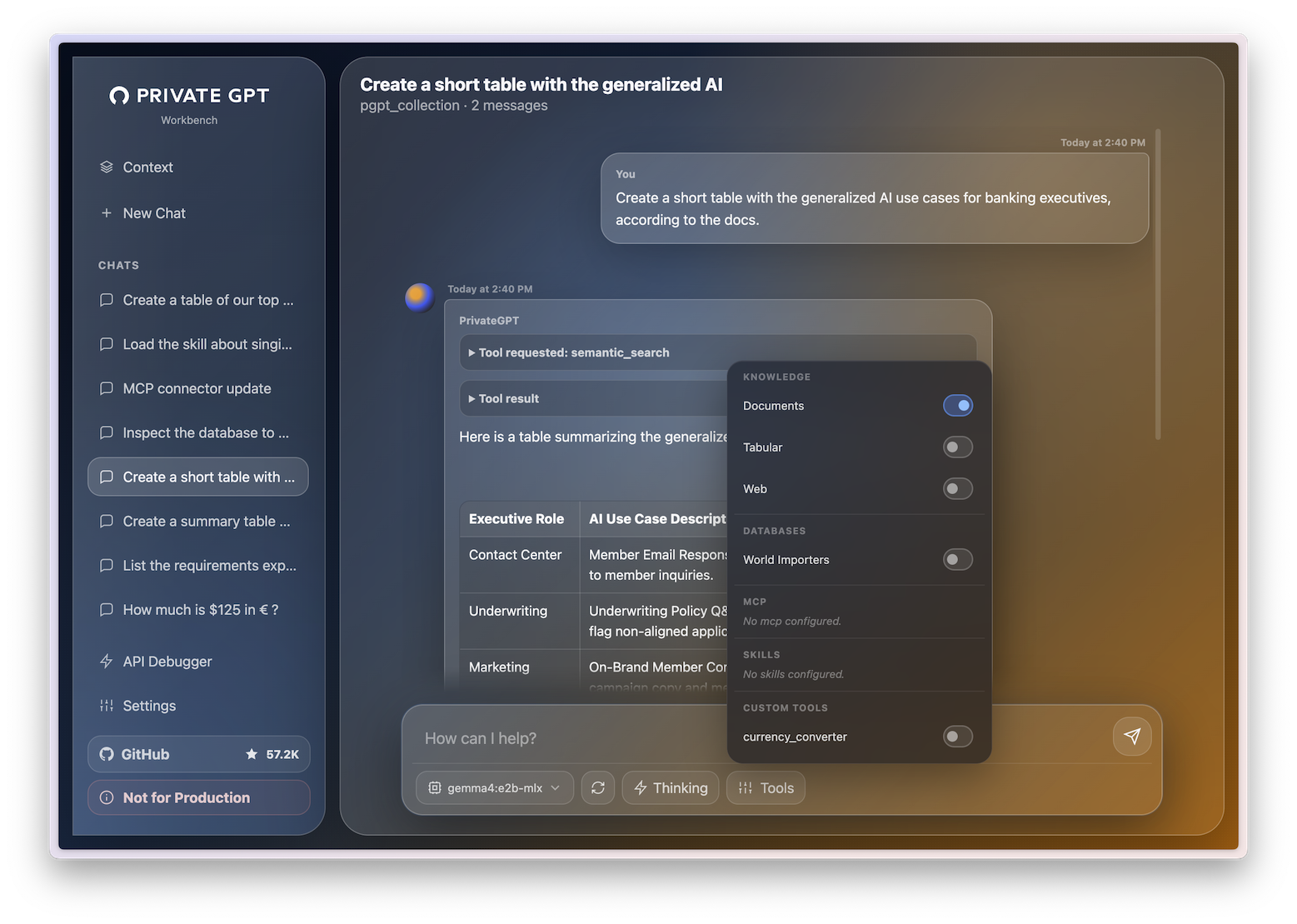
The UI is useful for:
- Sending messages.
- Selecting models from /v1/models.
- Uploading documents.
- Testing retrieval with citations.
- Enabling tools per chat.
- Configuring databases, MCP connectors, skills, and custom tools.
- Inspecting requests and responses through the API Debugger.
This UI is a demonstrator, not the core product. Developers are expected to build their own applications on top of the API. That said, the UI is intentionally polished enough for demos, videos, internal pilots, and quick local usage.
Integrations
 Claude Desktop / Cowork |  Microsoft Excel Claude add-in |  Microsoft Word Claude add-in |
 n8n |  OpenCode |  PrivateGPT Workbench |
PrivateGPT works natively as the local backend for the tools developers and end users already use.
| Integration Guide | What it enables |
|---|---|
| Claude Code | Use your local models as the backend for agentic coding in the terminal |
| Claude Desktop / Cowork | Connect the Claude desktop app and Cowork to your private models |
| Claude for Microsoft 365 | Run private AI inside Word, Excel, Outlook, and PowerPoint |
| OpenCode | Local AI coding assistant in the terminal |
Any tool that works with a local OpenAI-compatible provider will also work with PrivateGPT. The list below is non-exhaustive.
| Tool | Link |
|---|---|
| n8n | n8n.io |
| OpenClaw | openclaw.ai |
| Hermes Agent | hermes-agent.dev |
| VS Code | code.visualstudio.com |
| Cline | cline.bot |
Claude API compatibility
PrivateGPT follows the Claude API as the reference for modern AI application APIs. The goal is full coverage where it makes sense for a local, open-source layer.
| Area | Capability | Claude API | PrivateGPT |
|---|---|---|---|
| Models | Model selection | ✅ | ✅ |
| Messages | Messages API | ✅ | ✅ |
| Messages | Streaming | ✅ | ✅ |
| Messages | Batch / async processing | ✅ | ✅ async |
| Messages | Token counting | ✅ | ✅ |
| Knowledge | Files / artifacts | ✅ | ✅ |
| Knowledge | PDF and document ingestion | ✅ | ✅ |
| Knowledge | Retrieval with citations | ✅ | ✅ |
| Knowledge | Embeddings | ✅ | ✅ |
| Tools | Tool use | ✅ | ✅ |
| Tools | Tools in streaming | ✅ | ✅ |
| Tools | Built-in web search | ✅ | ✅ |
| Tools | Web extraction / fetch | ✅ | ✅ |
| Tools | Custom tools | ✅ | ✅ |
| Data | Database querying | Via tools | ✅ built-in |
| Data | CSV / tabular analysis | Via tools / code | ✅ built-in |
| Agents | MCP in the API | ✅ | ✅ |
| Agents | Remote MCP servers | ✅ | ✅ |
| Agents | Skills | ✅ | ⚙️ basic |
| Output | Structured outputs | ✅ | ✅ inference-dependent |
| Models | Vision | ✅ | ✅ model-dependent |
| Optimization | Prompt caching | ✅ | ❌ |
| Reasoning | Extended thinking | ✅ | ✅ |
| Platform | Token-based auth | ✅ | ✅ |
| Platform | OAuth / organizations | ✅ | ❌ |
✅ Supported · ⚙️ Partial / in progress · ❌ Not supported
Contributions are especially welcome in ⚙️ areas.
Why PrivateGPT? A brief history
PrivateGPT started as a proof of concept in 2023: a script that let you chat with your documents, fully offline, with no data leaving your machine. It went viral on GitHub, crossed 50K stars, and became one of the most-watched AI repos of that year.
That early version made one thing clear: there was serious demand for private, local AI that worked without cloud dependencies.
PrivateGPT 1.0 is the evolution of that idea — rebuilt from the ground up as a proper API layer for private AI applications.
How PrivateGPT compares
vs Ollama, LM Studio, LocalAI, vLLM, llama.cpp
These projects make it possible to run and serve models locally. They answer: how do I run a model?
PrivateGPT answers the next question: how do I build a useful AI application on top of that model?
Ollama / LM Studio / LocalAI / vLLM / llama.cpp  =  local inference layer
PrivateGPT                                        =  local AI application API layer
Use them together. Run your model with whichever inference server you prefer, then point PrivateGPT at it.
vs Onyx, Open WebUI
Both are valuable, but they are app-first experiences focused on chat and enterprise search. PrivateGPT is API-first. It provides the standardized local backend underneath those products — not the final product itself.
Onyx / Open WebUI  =  self-hosted AI applications
PrivateGPT         =  API layer for building self-hosted AI applications
PrivateGPT vs Zylon

PrivateGPT is maintained by the team at Zylon.
PrivateGPT is the open-source application API layer: messages, ingestion, tools, retrieval, citations, database access, tabular analysis, MCP, skills, and custom tools.
Zylon is the end-to-end AI Infrastructure orchestrating the hardware and software layers into a complete production platform for regulated organizations. On top of PrivateGPT, Zylon adds:
- Integrated inference server based on NVIDIA Triton + vLLM to run open-weight models.
- Concurrency, batch processing and load balancing capabilities to operate at scale.
- Kubernetes self-contained deployment with 20+ production services packaged and supported.
- CLI for installation, updates, model selection, and platform configuration.
- API gateway for governance and developer platform.
- Workspace application for non-technical end users.
- LDAP/Active Directory integration and RBAC user management.
- Telemetry, observability and operational monitoring.
- SIEM audit logs for compliance.
- SharePoint, Confluence, FTP, and Samba connectors.
- Disconnected (air-gapped) operation without external cloud dependencies.
- Integrated n8n Community Edition for workflow automation.
Use PrivateGPT if you want the open-source local AI application layer and developer API.
Use Zylon if you need the full enterprise AI infrastructure around it: deployment, governance, operations, user management, integrations, auditability, and support.
Learn more at zylon.ai · Book a demo
Community and contributing
- Discord — questions, show-and-tell, and release discussions
- Documentation — full reference, guides, and API docs
- Issues — bug reports and feature requests
- Community Forks — interesting forks and derivatives by the community
Pull requests are welcome. If your PR doesn't fit the upstream roadmap, you can add your fork to the Community Forks page instead.